Book Review: Pappyland
By Richard Thomas
Rating: B-
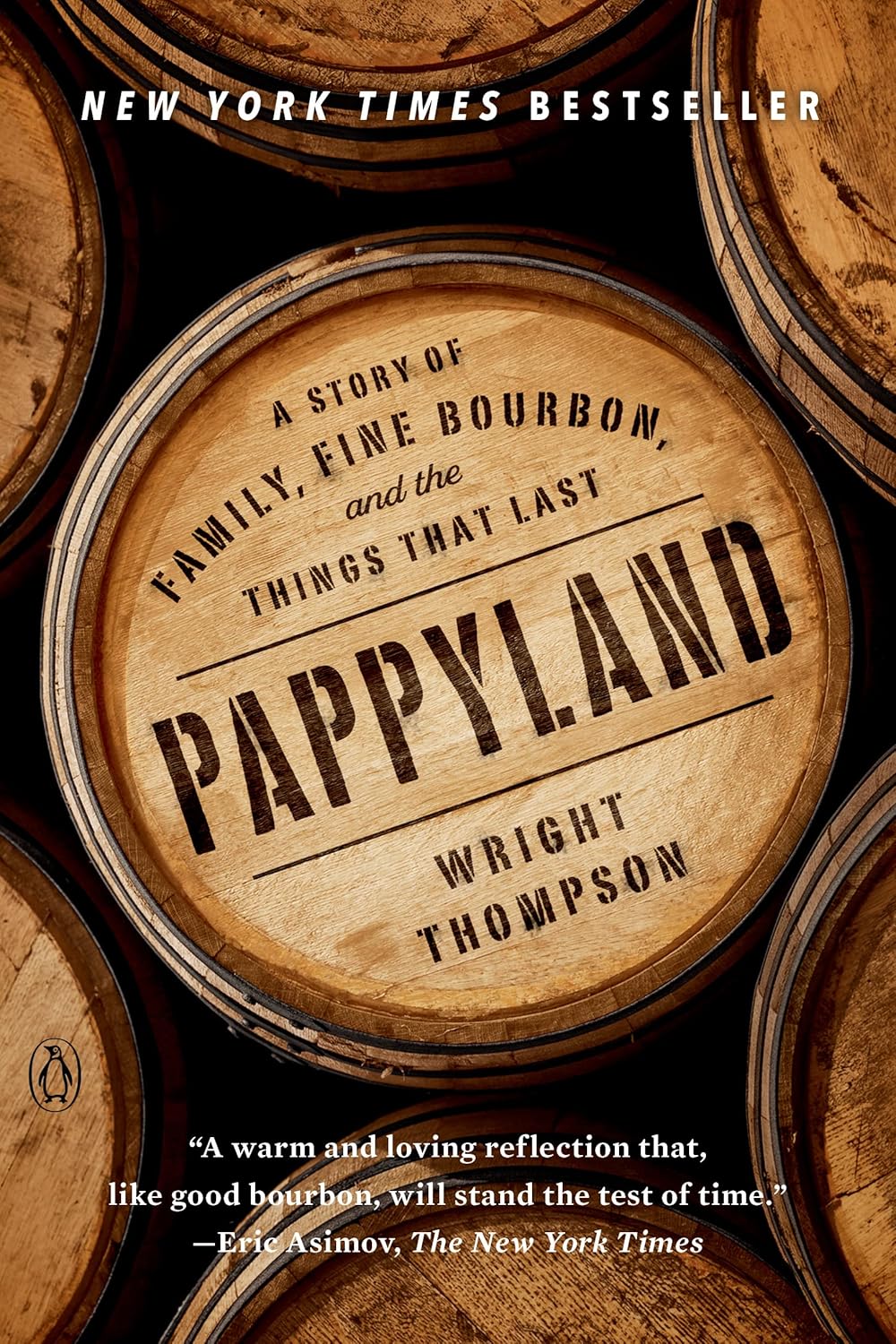 As I explained in an earlier book review, I am not a fan of gonzo journalism. Although the style of first-person reporting that allows to writer to enjoy a major case of main character syndrome was not invented by Hunter S. Thompson, it is because of him that we now call it “gonzo” and he popularized it in the 1970s. I really can’t read anything written in the style without thinking how self-important a person must be to make themselves the protagonist of someone else’s story. Mercifully, Wright Thompson’s Pappyland does not go quite as far as that.
Thompson is best known as a sports writer, so perhaps the best explanation for why he drove up from his home in Oxford, Mississippi to spend so much time shooting the breeze with Julian van Winkle III can only be explained by Pappy Fever, which was a well-established phenomenon by the time Thompson was working on this book. Pappyland was published in 2020, and although dates are rarely mentioned and his working arc never remarked upon, my guess is Thompson spent at least a couple of years in the mid-to-late 2010s visiting with van Winkle. Pappy Fever was already raging by the start of that decade, so how this project got started seems rather obvious.
Pappyland unfolds as a series of snapshots, each one taken during some time Thompson spent with van Winkle. Personal anecdotes flow from both men, and the reason I opened with a reference to my disdain for gonzo journalism is Thompson has very much made himself a major character in what is supposed to be the story of van Winkle, his bourbon dynasty of a family and the now renowned brand they created… but at least he did not make himself the main character and elbow the van Winkles off the stage. The tenor and weight given is really more like a buddy movie’s script, and that is what ultimately saves the work. The people who bought this book probably would have demanded their money back if it had turned out the same way Love and Whiskey did.
Folks wanting to read the van Winkle story will find plenty of interesting nuggets as Julian van Winkle relates his stories and observations to Thompson, but should be prepared for a meandering journey. Because so much of the tale weaves back, forth and all around, it feels like a longer narrative than it really is. Chronology is muddled, both in the telling and in the tales told. The Louie B. Nunn Oral History interview with van Winkle is much more direct, organized and informative, but the thing about Thompson’s book is one gets a much better feel for Julian van Winkle III as a man. Again, it reads like a buddy movie script, not popular non-fiction.