Q&A With of Bryony McNiven, Ardbeg Distillery Manager
By Richard Thomas
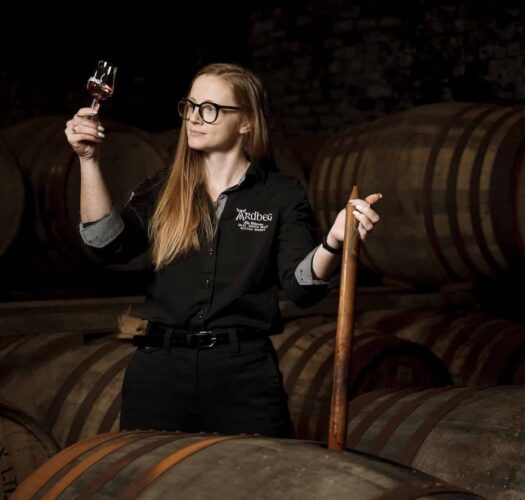
(Photo by Ben Shakespeare)
Adrbeg started 2026 with a bang by appointing a new distillery manager, choosing from inside their own house one Byrony McNiven. Ardbeg is a fan favorite among peat-headed whisky fans, as their smoky qualities stand out even on Islay, a Scottish isle famed for its smoky whiskies. So, who has their hands on the valve in the stillhouse is a major issue for those fans to get nerdy about. For the “women who whisky” part of the market, it’s an especially noteworthy appointment as the first people to hold that post were women. In a marked historical note for the mid-19th Century, the first distillers at Ardbeg were Margaret and Flora Mcdougal, sisters of the distillery founder.
News that McNiven would step into the role was first announced in September 2025, becoming official on January 1. After giving McNiven several weeks to get on top of things at Ardbeg, we were eager to check in with her for some Q&A.
RT: First, let me say thanks for taking the time to answer these questions; as I pose them, you’ve been on the job for six weeks. How much notice did you have that you would be made Ardbeg’s distillery manager?
BM: I had a little bit of time before my official start date, which allowed me the time to prepare for this exciting new chapter. Having grown up around Ardbeg and devoted my career to it, stepping into this role feels like a natural progression, and a true honor to continue the legacy of those who came before me.
RT: I understand Ardbeg is basically a family trade for you, as your father worked at the distillery and you grew up down the road from it. My understanding is that Ardbeg has also been your only employer since you graduated from University of Glasgow with your chemistry degree?
BM: That’s correct, Ardbeg has always been a part of my life. I grew up just down the road from the distillery, where my father, Ruaraidh MacIntyre, was a mainstay of the production team for over 35 years. I started with a summer job at Ardbeg while at school and university, which led to roles as a brand ambassador in Sweden, six years in the Whisky Creation Team, and most recently as Visitor Center Planner. It’s been an incredible journey, allowing me to develop professionally while staying connected to a place that means so much to me personally.
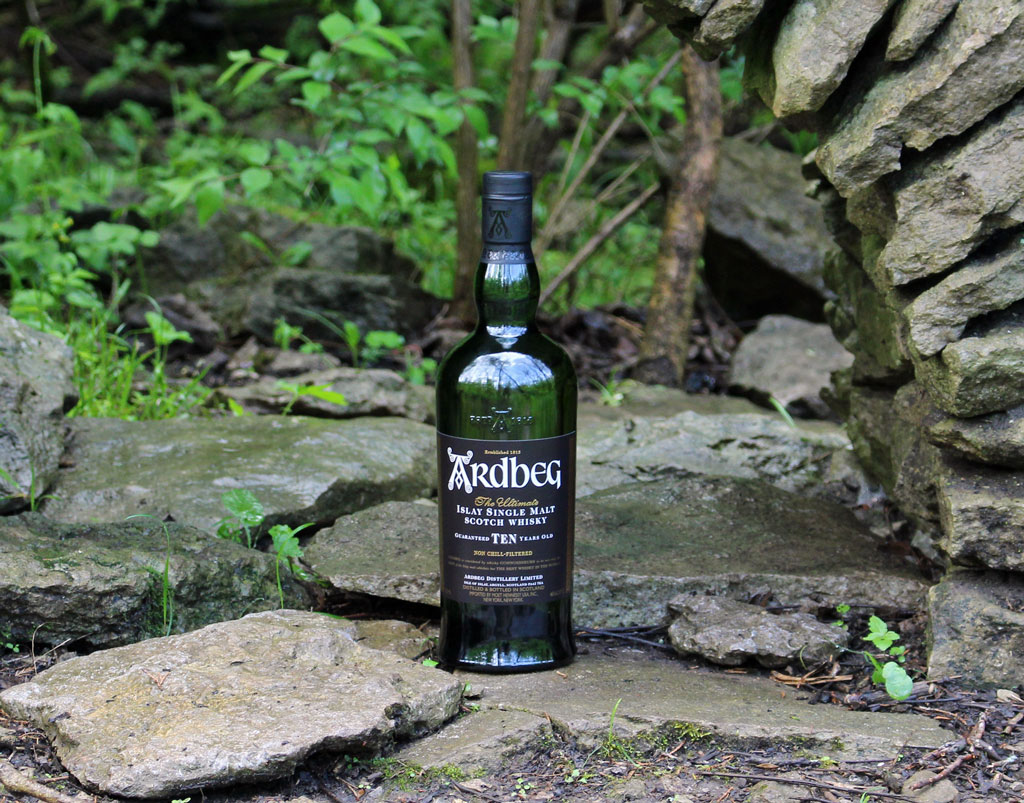
(Credit: Richard Thomas)
RT: About working for Ardbeg, it reads like you’ve done a bit of everything: brand ambassador, running the tourist center, being part of the creation team. Now you’ve circled back around to running the stillhouse, which has a different job description in Scotland than it does in the US. Can you explain what the distillery manager does and does not do, vis-a-vis your peers in Master Blender Gillian Macdonald and Dr. Bill Lumsden?
BM: As Distillery Manager, my main responsibility is overseeing the day-to-day production of Ardbeg’s spirit – ensuring every drop meets our high standards for quality and character. I work closely with our talented team to manage the stillhouse, mashing, fermentation, and sensory evaluation. While I collaborate with Gillian Macdonald (Master Blender) and Dr. Bill Lumsden (Director of Whisky Creation), their focus is on blending, maturation, and innovation. My role is to make sure the spirit is crafted to specification before it moves on to their expert hands for further development.
RT: Peat is arguably the most polarizing flavor/ingredient in the Scotch whisky industry. While I like to remind people that there are plenty of drinkers like myself, who enjoy peat but it’s not our end-all, it’s the folks who are decisively turned on or off by peat that get the attention. As the person doing new make whisky for one of the smokiest single malts in Scotland, and one with a background in educating folks about Ardbeg to boot, what do you say to people who are really turned off by peat to persuade them to give it a (often second) chance?
BM: Peat certainly sparks strong opinions! I always encourage people to approach peated whisky with an open mind. Ardbeg is renowned for its ‘peaty paradox’, a balance of intense smokiness with surprising sweetness and complexity. I often recommend trying Ardbeg in different contexts, like in a cocktail or paired with food, to discover its depth and versatility. Many people are surprised by the layers of flavor and end up appreciating peated whisky in a new way.
RT: Islay is strongly identified with peat; folks joke the island is made of the stuff, but it’s not just availability of what is essentially fuel. The peat in Islay is different in both composition and how that imparts flavor to the barley malt than the peat available elsewhere in Scotland. I can think of no one better to explain what makes Islay peat special than you.
(Credit: Richard Thomas)
BM: Due to our coastal location, Islay peat is unique due to the island’s rich flora, from heather and moss to maritime plants, with very little wood content. When peat smoke is used in malting, it introduces phenolic compounds that contribute smoky and earthy aromas. The resulting flavor profile has become closely associated with Islay’s peated whisky style.
RT: Your appointment neatly coincides with the opening of Ardbeg House, a new boutique hotel, on the island. I imagine you are too busy to be much involved with that now that it is off the ground, but before January dealing with tourists was part of your portfolio. So, I understand the hotel has a handful of quirky features?
BM: Yes, the timing has been remarkable! True to Ardbeg’s spirit, the hotel has its share of quirky features, from rooms inspired by our whisky expressions to unexpected nods to the myths and legends of Ardbeg and Islay. It’s designed to be a place where anyone can immerse themselves in the Ardbeg experience, right down to the smallest detail.