
Book Review: The Great Crossing — A Historic Journey To Buffalo Trace Distillery
By Richard Thomas
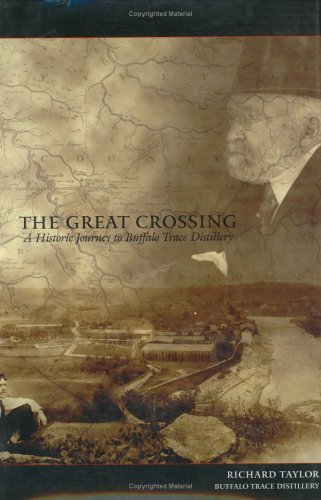 When The Great Crossing was published in 2002, it was a fair question if there would ever be a substantial audience for a book about bourbon, let along about bourbon in the 19th Century. Buffalo Trace Distillery itself had only been rebranded in 1999, and this book was part of marketing that rebranding, underlining the legacy E.H. Taylor, Jr. and positioning Buffalo Trace to claim it. The effort was so successful that Taylor is now much more often associated with Buffalo Trace than any other. That includes Castle & Key, which was founded by and named after Taylor, the only distillery in Kentucky that formally bore his name.
The book is written by Richard Taylor, descendant of E.H. Taylor and an accomplished historian and writer. A former Kentucky poet laureate, dean of the Governor’s Scholars Program and English professor at Kentucky State University and Transylvania University, he retired from academia in 2022 and was inducted in the Kentucky Writers Hall of Fame in 2023. He has written several books, including not just histories and collections of poetry, but fiction as well. So, don’t let the book being written for and published by Buffalo Trace throw you; the author behind it was an accomplished figure 24 years ago and only moreso since, not some anonymous marketing hack. Taylor even co-owns Poor Richard’s Books, an institution of downtown Frankfort, Kentucky.
The Great Crossing is less a history of Buffalo Trace, though, than a history of the distillery site as it relates to Taylor’s own family. Starting with when Taylors first arrived at the ford of the Kentucky River that would eventually come to be called Leestown, it traces the site from the frontier days to E.H. Taylor’s purchase of it, through his bankruptcy and George T. Stagg’s rescue of the distillery. From there, it follows Taylor’s career more than developments at Buffalo Trace.
So, despite the title, it is key to understand this is a book first and foremost about E.H. Taylor, Jr. Even the Taylor clan is dealt with only as it connects to Edmund Haynes or the Buffalo Trace site, and the larger story of the distillery goes largely unexamined. The decades from Albert Blanton era to Sazerac’s ownership are dealt with in only the last three pages of what is already a short, 109 page book. My main criticism of the book is that, in that the title is somewhat misleading, and it’s a criticism I have heard spoken from Buffalo Trace fans from time to time.
The book cannot even be described as a proper biography, because it barely glances at anything to do with Taylor outside of the whiskey business. But as a history of E.H. Taylor, whiskeyman, it’s excellent. So, taking that narrow focus in hand, Richard Taylor has penned a valuable resource for anyone who wants to understand this one person and his place specifically in Buffalo Trace’s story, and to a certain extent beyond that. It’s a cornerstone book for Trace enthusiasts, but importantly, remember there are four corners in most buildings.