Kirin To Put Four Roses Up For Sale
By Richard Thomas
Whiskey observers were shocked at the end of last week as word broke that Kirin Holdings Company intended to sell Four Roses for $1 billion. The news arrived in the midst of sliding sales afflicting most of the world’s whiskey industries.
According to reports, Kirin was exploring the sale with advice and services provided by UBS Financial Services. Although Kirin would not comment in news reports, said reports nonetheless stated that it was said the Japanese conglomerate wanted to pivot away from its spirits business and focus more on its healthcare companies.
Although Kirin began as a brewery in 1885 and is best known as a drinks company, in the true style of a Japanese conglomerate, drinks is far from the only thing the company is involved in. In addition to breweries around the world, Four Roses and a chunk of Coca Cola in North America, Kirin is also in food services, logistics, engineering and Japanese health care. The principal company in the latter holdings is Kyowa Kirin, a biotech and pharmaceutical firm.
Kirin and Four Roses
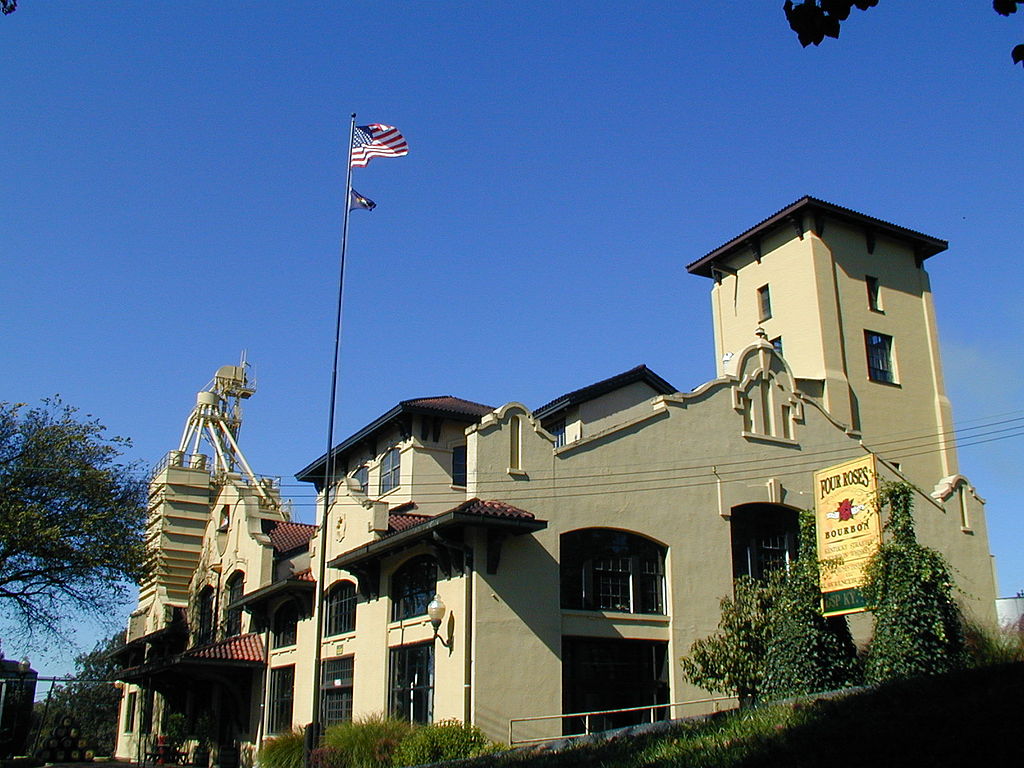
At the beginning of the 21st Century, the Four Roses brand was rotgut in both its whiskey and its reputation in the United States. The brand had fallen far from its 1930s heyday, when it was a well-regarded bourbon brand. The Old Prentice Distillery, the brand’s home base, was practically an anonymous manufacuring center for the Canadian holding company Seagram, largely concerned with producing constituent whiskeys to be used as parts in Seagram’s many products. Much like Kirin today, although Seagram was best known as a drinks conglomerate, they were in reality a wide-ranging holding company, and an attempt to move into entertainment media led to the company’s implosion in 2000. Seagram was dissolved and its may assets sold.
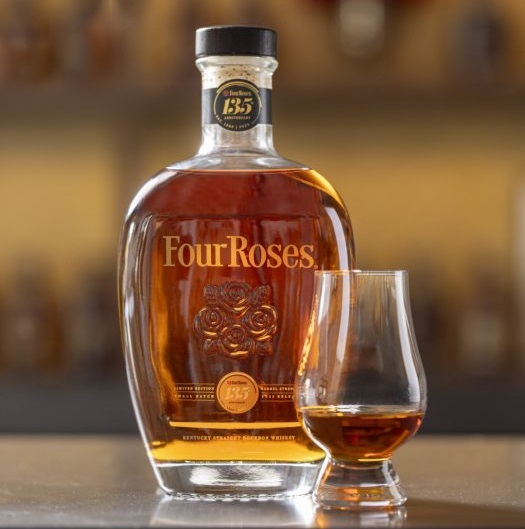
(Credit: Kirin)
While Four Roses had a terrible reputation in the US, they were well-regarded in Japan. This was because the original Four Roses bourbon continued to be sold as an export product there, while in its home market the brand was used to push the inferior blended whiskey Americans identified it with. In the wake of Seagram’s demise, Old Prentice and the brand rights passed through many hands before ultimately being acquired by Kirin in 2002. The Japanese company, familiar with what Four Roses could be as well as with some of the infrastructure behind it through previous dealings with Seagram, knew the company was an undervalued gem: they bought Four Roses for $165 million. Adjusted for inflation, that price tag would be $298 million today.
What The News Means
First and foremost, just because Kirin is exploring the sale and a desired price has been made known does not mean any deal will transpire. To point to just Kirin’s own recent history, the company was in talks to merge with Suntory in 2010. A deal was widely anticipated, but never happened, and Suntory bought Beam Global in 2014 instead. The news is certainly dramatic, but nothing may come of it.
Next, the buzz surrounding the news is that Kirin is running away from whiskey in the wake of its declining position globally. While that could be part of it, I think that conclusion is being overstated for two reasons. The most obvious is Kirin has built up Four Roses into the world’s eighth-largest bourbon brand. Their stated asking price of $1 billion represents a richly sweet flip if realized, since the price is more than triple the value of what they paid for it almost two decades ago. Kirin is clearly not afraid of the market or in an urgent need to sell if that is their opening position.
However, there is a wrinkle in that picture worth considering, and that is how President Donald Trump has turned a Four Roses strength into a weakness. The company is reported as shipping 1 million cases annually, of which 425,000 were for the domestic market. That makes it a top export success for an American whiskey company, which had been a major source of strength. Learning from the experience of the 1970s, American distillers have come to look at a diversified export portfolio as the best guarantee against changing trends in their home market. Enter Trump and his blundering trade war, which caused US whiskey exports to plunge 70% this year. That is on top of the damage already done to US whiskey exports during Trump’s first trade war in 2018.
Weak sales in the US, driven by the preferences of the rapidly maturing Gen Z, poses a problem for whiskey companies around the world. But Trump’s trade war is especially punishing for those companies who were most successful in building alternate markets against the very rainy day that is now arriving and has long been anticipated by the US whiskey industry. Four Roses is one of those companies. In that respect, the ideal window for flipping Four Roses has already passed; it would have been better to have begun this process in 2021 or 2022.
That said, we should all be careful in attributing too much to considerations outside the company itself. The desire to sell Four Roses may be entirely about Kirin’s internal, corporate politics and objectives. Perhaps the company is serious about its intention to focus more on their healthcare business; their main stake in drinks is in the beer business, so selling a valuable company like Four Roses makes sense if the point is to generate capital for the acquisition of another Japanese healthcare company. The truth is no one outside of Kirin’s own board room really knows the why or even the what of the Four Roses news.