
Sour Mash And Sweet Mash 101
By Richard Thomas

(Credit: Elisa Miller)
While I was promoting my latest book, Behind the Bottle: Jack Daniel’s, earlier this spring, I fielded more than a few questions about what the difference is between sour mash and sweet mash whiskey-making. If that seems off-topic, I initially found it a little odd as well, but I have since chalked it up to Jack Daniel’s being labeled as a “Sour Mash Tennessee Whiskey.” It’s right there on every bottle.
The basics and distinctions of sour and sweet mash whiskeymaking is the sort of thing that should feature in every distillery tour in the US but is rarely done with the attention it deserves. That is because a given distillery uses one method or the other and naturally thinks the way their chosen method is better. So, even if you receive a 101-level chemistry lesson on the tour, it won’t be unbiased.
What Is Sweet Mash Whiskeymaking?
A summary of the first half of how to make whiskey is get some grain, cook it so enzymes can convert the starch into sugar, and allow that to cool so yeast can ferment the sugar into alcohol. If that is exactly what is done with no extra steps, then you have sweet mash whiskeymaking.
Enter Sour Mash
No one knows who actually invented the sour mash process, but versions of it are known to have predated the early 19th Century. That is when Dr. James Crow did the laboratory work needed to perfect and codify sour mash whiskeymaking into something recognizable today. Crow was a Scottish physician and chemist who immigrated to Kentucky, and worked at distilleries in the Glenn’s Creek area (where Woodford Reserve and Castle & Key are today) in the 1830s.
(Credit: Joana Thomas)
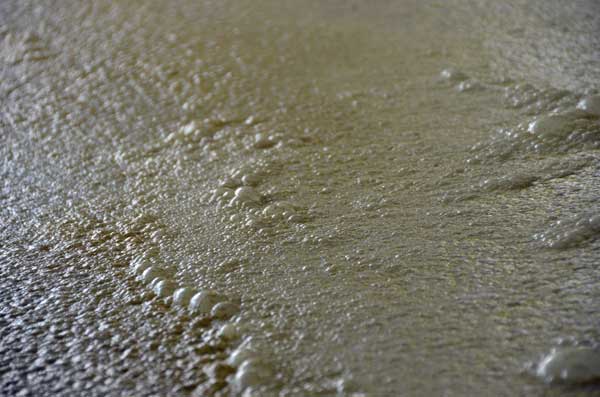
This process involves recycling mash from the previous batch back into a new batch. This backset is acidic and thus referred to as “sour.” Incorporating some of the used mash back into the new mash helps set the acidity and other conditions in the new mash, helping protect it from bacterial contamination and establish consistency between batches.
To understand the advantages of the sour mash process, one needs to remember the conditions of 19th Century whiskeymaking. Fermenters in that era were not the smooth stainless steel containers so often seen today, but often made of wood. When metal was used, such as copper, it would have been fashioned of riveted sheets rather than welded. Without proper, thorough cleaning, either type of fermenter would offer vast nooks and crannies for microorganisms to stay behind and infect the next batch of mash.
Germ theory was a development of that middle part of that century: the earliest major figure in modern germ theory was Ignaz Semmelweis, who did his work in the late 1840s. Louis Pasteur would not begin his work on the subject until a decade later. The whiskey industry’s understanding of the origins of their contamination problem would have been limited, with even Crow himself having only a rudimentary understanding of why it was a problem. Sour mash originated in solving a problem that was at first not understood at all, and later only poorly understood.
Sour Mash Advantages
In the modern context, where germ theory is very well understood (outside of MAHA circles, anyway). Stainless steel makes cleaning simpler. Yet the process still offers an easy way to maintain consistency between batches, which matters when making whiskey on a large scale. Also, big distillers have a major disposal problem with their spent mash, or stillage. At a large distillery, using backset for 20 to 30% of the new batch of mash is common, and that helps mitigate the stillage disposal problem.

(Credit: Wilderness Trail)
Why Use Sweet Mash?
Sweet mashing has had its own advantages, so much so that sweet mash is a traditional feature of Pennsylvania whiskeymaking (Kentucky and Tennessee were better known for sour mash). The main reason is that one man’s consistency is another man’s straitjacket. Basically, without the backset setting the conditions each time, the whiskeymaker is free to tweak the process and thereby tweak the flavors.
The problem is found in that phrase I used before, “an easy way to maintain consistency.” Nothing about sweet mash is easy. The process requires more monitoring, more control over the mashing and fermentation process, and much stricter attention to sanitation. This is why today, sweet mash is often the purview of craft distillers or mid-sized distillers at most, while the big distillers all use sour mash.