Old Elk 10 Year Old Wheat Whiskey Review
By Richard Thomas
Rating: B+
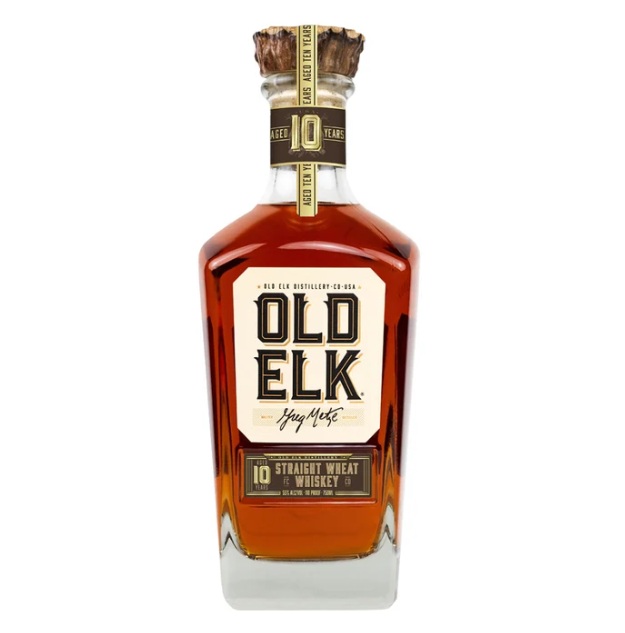
(Credit: Middle West Spirits)
When it comes to Old Elk, many casual drinkers and enthusiasts share a basket of misunderstandings and misconceptions about what separated the brand from other non-distiller producers (NDP). First, there is the simplification that because Old Elk had a tight relationship with Indiana-based MGP before being acquired by Middle West Spirits, they were sourcing their whiskey there. In fact, much of what Old Elk bottled was contract-produced by MGP under the supervision of that distillery’s longtime Master Distiller Greg Metze, often using variants of MGP recipes.
Take for example the wheat whiskey behind this 10 year old expression. The mash bill is 96% wheat and 4% malted barley, making it very close to MGP’s stock wheat whiskey, but still distinct in the sense that it was clearly made for Old Elk. Not everything Old Elk bought from MGP was made under contact in this way; their standard wheat whiskey is drawn from MGP’s base stock of 95% wheat, 5% malted barley whiskey. But it just goes to show that some of the things Old Elk had been up to did not just boil down to “they bought a bunch of barrels from MGP in the early days of the Bourbon Boom.”
Another distinguishing feature of Old Elk whiskeys was their use of what they called the Slow Cut process, borrowed from other wings of the spirits industry. The idea is based in the very real, reactive chemistry of adding new water to the recently dumped, high proof spirit coming out of the barrels. Adding the water slowly and over time tempers that chemistry. As to why everyone does this, it extends the period the whiskey will sit in tanks between dumping and bottling, tying up equipment. Old Elk is not the only American Whiskey company that used this method; Virginia Distilling Co. and Lost Lantern have been known to employ it as well. But there are only a few and Old Elk adopted it early.
The Whiskey
Bottled at 103 proof, I thought that despite that relatively high proof point and quite mature aging, the whiskey took on a light amber appearance in the glass. The nose came on with a dense current of caramel and melted brown sugar, accented with hints of dried cranberry and strawberry. The palate turned that about 45 degrees, combining vanilla with mango and red grapes, with the fruity part turning dry on the back end when a spicy wave comes in and sweeps it all away. The finish carried on with that spicy wave, but this swiftly passes leaving behind a lingering dose of oakiness.
The Price
Expect to pay $70 a bottle for this item.